






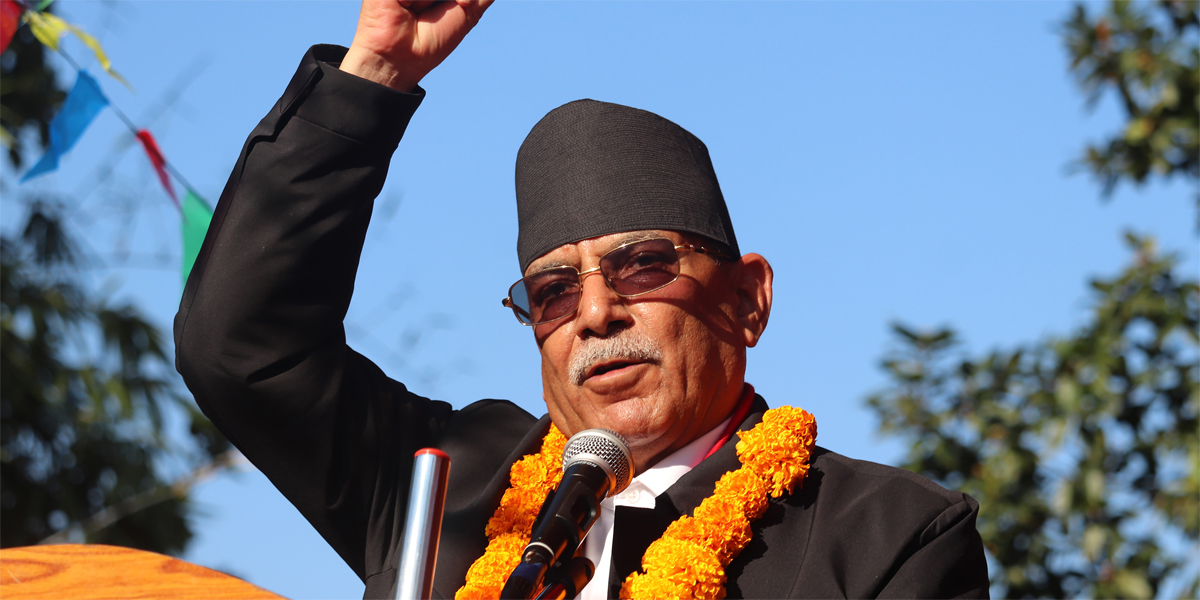

Pokhara, 7 March| Pushpa Kamal Dahal ‘Prachanda’, the coordinator of the Nepali Communist Party and a pivotal figure in Nepal’s political transition, has managed to secure a victory in Rukum East during the 2082 parliamentary elections. According to the official counting, Prachanda garnered 10,240 votes, a tally that ensured his presence in the next House of Representatives. However, this individual success comes at a time of profound crisis for his political organization, as the Maoist movement faces its most significant electoral setback since entering mainstream politics. While Prachanda celebrated his win in a district historically considered a bastion of the Maoist insurgency, the broader national landscape paints a picture of a shrinking party and a leadership increasingly disconnected from the changing aspirations of the Nepali electorate. During his campaign, Prachanda had boldly claimed that he is currently the only leader in Nepal who can win from any constituency he chooses to contest. This rhetoric, however, has met with sharp internal and external criticism, with many pointing out that his frequent changes in electoral constituencies—moving from Rolpa and Kathmandu to Siraha, Chitwan, Gorkha, and now Rukum East—reflect a deep-seated political insecurity rather than a position of absolute strength.
The paradox of Prachanda’s career is highlighted by the fact that Rukum East, the site of his latest victory, is an area where the Maoist movement suffered immense loss of life and property during the decade-long civil war. In such a stronghold, any candidate from the party would likely have secured a similar number of votes, as the tally of 10,240 roughly matches the core party membership and traditional sympathizers in the region. Critics argue that by seeking refuge in such “safe” zones, the top leadership has prioritized personal survival over the collective growth of the movement. This sentiment is further exacerbated by the failure of his close family members in this election cycle. Despite the party’s efforts to establish his daughter and daughter-in-law in influential positions, both suffered defeats, a result widely interpreted as a public rejection of nepotism and family-centric politics. While his daughter, Renu Dahal, has maintained some public sympathy due to her developmental work in Bharatpur, the overall mandate suggests that the voters are no longer willing to grant a free pass based on revolutionary lineage alone.
The 2082 election results have been particularly brutal for the established political forces, with the Rastriya Swatantra Party (RSP) emerging as a dominant alternative, leading in 120 seats and securing nearly 200,000 proportional representation votes. In contrast, the Maoist party, which once held nearly a two-thirds majority after the 2008 Constituent Assembly elections, has been reduced to a marginal force, leading in only about 10 to 12 seats. Despite this catastrophic decline, there has been a noticeable absence of moral accountability within the top leadership. Instead of engaging in rigorous self-reflection or taking responsibility for the party’s shrinking influence, Prachanda has continued to project an image of power, famously comparing himself to a “lion in the forest” whose mere presence should intimidate others. This defiant posture has drawn comparisons to his past rhetoric when he famously described the parliament as a “butcher shop,” leading many to question the ideological consistency of a leader who once led a violent struggle against the very system he now clings to for survival.
Furthermore, the strategic maneuvers employed by Prachanda before the election, including the unification of over two dozen small communist factions into a “Great Communist Center,” appear to have been largely symbolic and ineffective. These mergers, intended to create a formidable electoral bloc, failed to translate into actual votes at the polling stations, proving that paper-based alliances cannot substitute for grassroots organizational strength. Inside the party, a sense of disillusionment is growing as senior leaders and co-coordinators, including former Prime Minister Madhav Kumar Nepal, faced defeat. Rather than sharing the burden of these losses, Prachanda has focused on his status as the “senior-most leader” in the parliament, a title he holds solo as other former premiers failed to secure their seats. This tendency to convert collective adversity into personal political capital is a well-known trait of his leadership style, yet it appears to be losing its efficacy as the party continues to fragment and wither.
The broader philosophical and psychological implications of this leadership crisis cannot be ignored. Political analysts suggest that leaders like Prachanda and his contemporaries have fallen into the trap of “gerontocracy,” where age and past contributions are viewed as permanent licenses to hold power. This psychological state, characterized by the belief that the nation or party cannot survive without a specific individual, often leads to the stifling of internal democracy and the transformation of a political institution into a private company run by a small clique of loyalists. As the Gen-Z movement and newer political waves demand fresh faces and transparent governance, the old guard’s refusal to transfer power is being met with a ruthless mandate at the ballot box. Prachanda’s insistence on his own indispensability, even as the ideological pillars of his movement crumble, suggests a tragic end to a revolutionary legacy. Without a genuine return to the masses and a willingness to step aside for a new generation, the “lion” may find himself ruling over an empty forest, as the voters have clearly indicated that they are ready to move beyond the era of historical inheritance and towards a future defined by performance and accountability.