










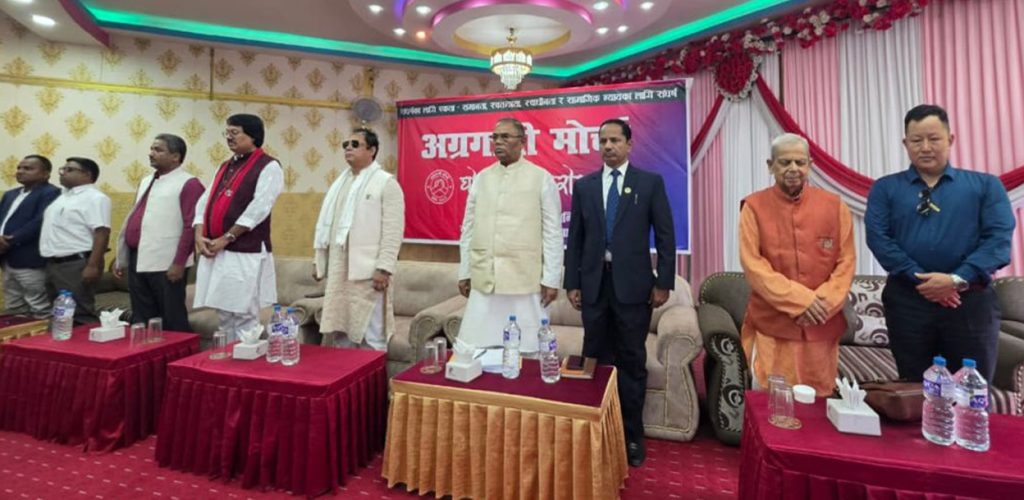

Pokhara, 7 August| Eight Madhes-based political parties have formed a new alliance called the ‘Progressive Front’ in an effort to protect their political relevance after suffering a major setback in the latest House of Representatives election. The alliance brings together Janata Samajbadi Party Nepal, Janamat Party, Nepal Federal Socialist Party, Bahujan Ekata Party and four other parties. The coalition was formally announced on 23 July amid growing discussion over the declining influence of Madhes-based parties in national politics.
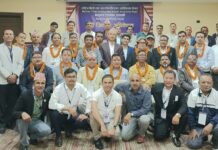
The other parties in the alliance include Aam Janata Party, Nagarik Unmukti Party Nepal, Progressive Democratic Party and Khumbuwan Rastriya Morcha. At the declaration programme held at Kathmandu Banquet in Thapagaun, New Baneshwor, the parties presented a common concept paper pledging to unite democratic, progressive, social democratic, revolutionary, workers’, socialist and inclusive political forces.
The Progressive Front has identified freedom, equality, democratic republicanism, inclusive democracy, secularism, social justice and human rights as key elements of its political agenda. It has also pledged meaningful participation, proportional representation and equal opportunities for Madhesis, indigenous nationalities, Tharus, women, Dalits, Muslims, marginalized communities, youths, farmers and workers at all levels of the state.
The alliance has further highlighted transparent, accountable and corruption-free governance, an independent judiciary, capable public administration, and accessible education and health services. The concept paper has been signed by the chairpersons and senior leaders of the eight participating parties.
The formation of the front has brought Madhes-based parties back into political discussion after their influence declined significantly in recent years. Parties that emerged from the Madhes movement had previously played a major role in Madhes Province politics and had also participated in governments at the federal level. However, internal divisions, repeated changes in political alliances, a strong focus on power-sharing and criticism over poor governance gradually weakened their public support.
The decline became particularly visible in the 2079 BS election, when the Janata Samajbadi Party Nepal led by Upendra Yadav and the Loktantrik Samajbadi Party Nepal led by Mahantha Thakur suffered electoral setbacks. The Loktantrik Samajbadi Party failed to retain national party status. Meanwhile, Janamat Party, led by CK Raut, emerged as a new political force, winning six seats in the House of Representatives and securing national party status. It also became the fourth-largest party in the Madhes Provincial Assembly.
However, Janamat Party also faced growing criticism over its performance in government, particularly regarding its commitments to farmers, good governance and public issues. Its perceived focus on power politics contributed to a decline in public confidence, according to political observers. In the latest House of Representatives election held on 21 February, the Madhes-based parties failed to win a single seat, leaving them with a serious challenge to maintain their political presence at the national level.
Political observers have therefore interpreted the Progressive Front as an attempt to rebuild political strength and protect the existence of regional parties. There is also speculation that the alliance may be preparing for the upcoming local and provincial assembly elections, where the parties could seek to retain influence by coordinating their political and organizational resources.
Political analyst and Madhes affairs expert Roshan Janakpuri said the parties were facing a serious crisis of political existence and may have formed the front to regain public trust and prepare for future elections. He also pointed to the growing organizational expansion strategy of the Rastriya Swatantra Party in the Tarai-Madhes region as another factor that could have encouraged Madhes-based parties to work together.
According to Janakpuri, the political environment in the Tarai-Madhes remains fluid, while major established parties maintain stronger organizational networks in many hill areas. In such circumstances, the Rastriya Swatantra Party could view the Madhes region as an important area for expansion. This could increase pressure on regional parties and encourage them to consolidate their political strength through a common platform.
Janakpuri, however, cautioned that the front would not automatically become a strong political force simply because several parties have joined it. He said the parties would need to move beyond electoral calculations and develop a clear political agenda focused on public concerns. Issues such as federalism, republicanism and democracy would need to be addressed consistently if the parties want to rebuild public confidence.
Political analyst Tula Narayan Sah also described the alliance as an effort by weakened regional parties to protect their political existence. He said the latest electoral results had reduced the Madhes-based parties to a politically vulnerable position. In his view, forming a front allows them to maintain political activity, rebuild organizations and remain visible before the next round of elections.
Madhes affairs expert and political analyst Chandrakishore has offered another interpretation, describing the Progressive Front as a possible pressure group comprising political forces outside Parliament. He suggested that concerns surrounding the government, constitutional arrangements, democracy and the future of federalism could have encouraged the parties to create a common platform for exerting political pressure.
Chandrakishore also noted that many of these parties had largely disappeared from political discourse after the election, but their renewed cooperation has brought them back into public discussion. However, he argued that simply bringing the old parties together would not be enough. They would need new political messages, credible leadership and changes in their previous political practices to regain public support.
The coming local and provincial elections will therefore provide an important test for the Progressive Front. If the participating parties can establish a clear agenda, improve their organizational structure and reconnect with voters, they may have an opportunity to regain some political ground. If the alliance remains focused only on electoral calculations or preserving the influence of existing leaders, its ability to create lasting political momentum could remain limited.
For now, the formation of the Progressive Front has given the weakened Madhes-based parties a new platform and returned them to the political conversation. Whether the alliance becomes a durable political force or remains a temporary arrangement for electoral survival will depend largely on its future agenda, leadership, organizational coordination and ability to respond to public expectations.