












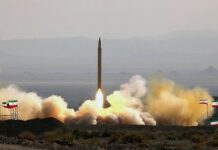





Pokhara, 9 September | Iran’s reported test of a new anti-ship cruise missile aimed at a U.S. warship has added another layer of tension to the already volatile security situation in the Middle East. While military powers generally test new missiles and weapons systems over open waters or uninhabited land, the reported Iranian test was carried out with a U.S. warship in the Persian Gulf as the intended target. There is no confirmed evidence that the missile directly struck or physically damaged an American warship. The U.S. Navy has maintained that none of its vessels was directly hit by an Iranian missile. However, reports that American warships moved farther away after the missile approached the area have raised questions about the strategic significance of the incident.
Iran has previously relied heavily on subsonic anti-ship missiles, which are generally considered easier for sophisticated naval air-defense systems to detect and intercept than faster weapons. The missile involved in the latest reported test has been described as a supersonic system using ramjet propulsion technology allegedly developed with Russian assistance. A ramjet can allow a missile to maintain very high speed while flying at low altitude, potentially reducing the time available for a defending warship to detect and respond to an incoming threat. However, independent confirmation of the missile’s exact model, speed, propulsion system and operational capability remains limited.
Iran has presented the incident as a demonstration of military capability and a warning to the United States. Washington, meanwhile, has rejected the suggestion that an American warship was directly struck. From a military perspective, however, the absence of physical damage does not necessarily mean that the event had no strategic significance. One possibility is that Iran deliberately directed the missile close to the warship as a warning rather than attempting to destroy it. Another possibility is that the missile failed to reach its intended target because of electronic warfare, defensive countermeasures or another technical factor. Neither explanation has been independently established.
The reported incident has also brought renewed attention to military cooperation between Iran and Russia. According to the claims presented in the material, Iran’s military cooperation with Russia expanded against the backdrop of the war in Ukraine, with Tehran allegedly providing drones and other military assistance while receiving access to advanced Russian technologies. Russian missile specialists have reportedly assisted Iranian engineers with ramjet propulsion, airflow management and thermodynamic improvements. The claims suggest that Iran may be seeking not merely to acquire finished missiles but to develop domestic production capabilities. However, the details of the alleged technology-transfer program have not been independently verified.
The Strait of Hormuz has emerged as another major point of concern. The strategic waterway is one of the world’s most important routes for energy transportation, and any threat to shipping could have consequences far beyond the immediate region. The information provided claims that the United States has declared the waterway safe and said that naval forces have removed maritime mines. It also refers to an oil tanker accident allegedly caused by a mine, resulting in deaths among the crew and significant damage to the vessel. The circumstances of that incident and the precise cause of the explosion would require independent verification before the claims could be treated as established facts.
Meanwhile, the reported movement of the USS Abraham Lincoln and the deployment of the USS George Washington to the Arabian Sea have also been interpreted through the lens of rising tensions with Iran. U.S. military officials have described such movements as part of normal and previously planned force rotations. Some analysts, however, have questioned whether prolonged deployments in a high-threat environment could create serious physical and psychological pressure on personnel and increase maintenance requirements for naval assets. Claims that the Abraham Lincoln suffered major hidden damage from Iranian attacks or that its personnel faced a mutiny have not been independently confirmed.
The wider debate concerns the limits of U.S. military power against Iran. The material cites reporting and analysis suggesting that American officials may increasingly recognize the difficulty of achieving a decisive outcome through sustained military strikes alone. According to the claims, Washington could therefore place greater emphasis on economic sanctions, international diplomatic pressure and negotiations aimed at limiting Iran’s nuclear and military capabilities. U.S. President Donald Trump has publicly emphasized American military strength and repeatedly claimed that Iran’s capabilities have been severely weakened. Yet the reported developments suggest that the strategic reality may be considerably more complicated than public political statements indicate.
The reported missile test therefore matters even without evidence of a direct hit. Iran’s growing emphasis on asymmetric warfare, drones, maritime attack capabilities and high-speed missiles could complicate the traditional advantages enjoyed by the U.S. Navy. At the same time, many of the specific claims surrounding the missile test, alleged Russian technology transfers, hidden damage to American warships and personnel unrest remain unverified. They should consequently be treated as claims or analytical interpretations rather than established facts. If tensions continue to rise, both Washington and Tehran are likely to rely not only on military power but also on maritime control, economic pressure and diplomacy. The incident nevertheless highlights how quickly developments in the Persian Gulf can reshape perceptions of military deterrence and the broader balance of power in the Middle East.