

















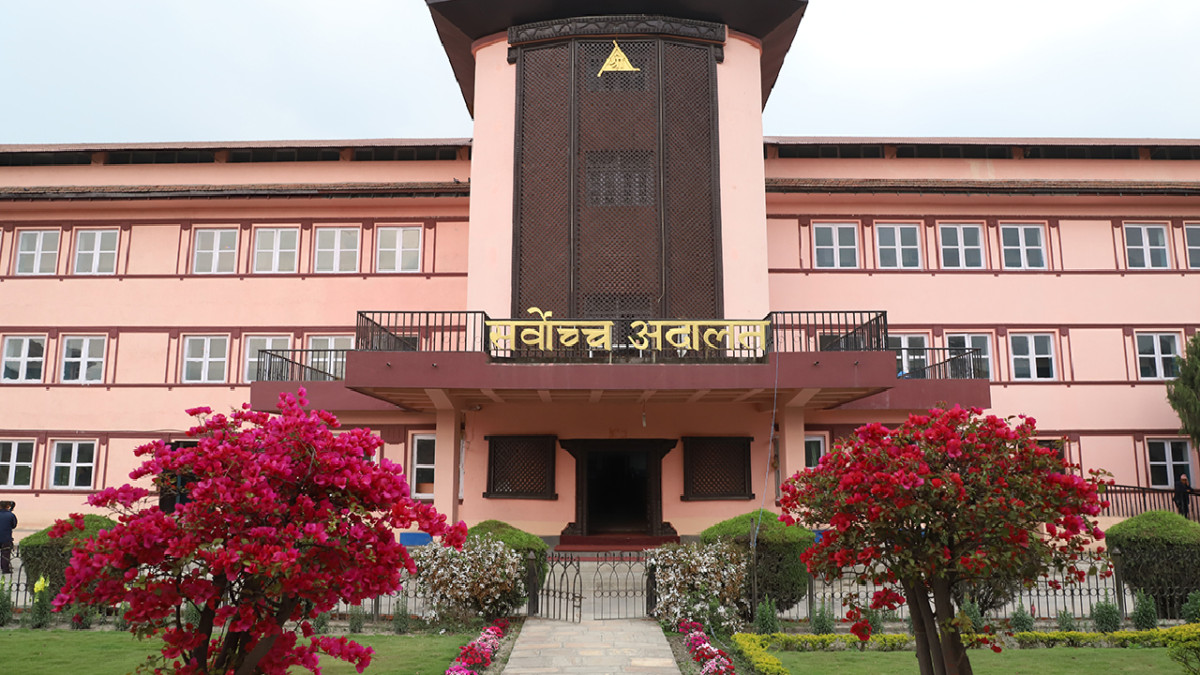

Pokhara, 16 September | The Supreme Court of Nepal has issued an interim order preventing the immediate implementation of two provisions of the House of Representatives Regulations, 2083, after finding that their compatibility with the Constitution required judicial consideration. The order has brought renewed attention to the constitutional requirement that a constitutional amendment bill must be approved separately by both houses of the Federal Parliament with at least a two-thirds majority of the total members currently in each house.
Article 274(8) of the Constitution provides that a bill seeking to amend the Constitution must be passed by at least a two-thirds majority of the total number of members currently in both houses of the Federal Parliament. The dispute arose after the House of Representatives adopted the House of Representatives Regulations, 2083, with provisions concerning the procedure for constitutional amendment.
The petition challenging the provisions was filed by Kamala Pant, leader of the Nepali Congress parliamentary party in the National Assembly, along with others. The petitioners argued that certain provisions of the House regulations conflicted with the bicameral structure of Nepal’s Federal Parliament and could undermine the constitutional role of the National Assembly.
One of the central provisions under dispute was Rule 140(11). The provision stated that when a bill returned from the National Assembly with a message reached a two-thirds threshold based on the total number of members of both houses, the process for authentication could proceed. The petitioners argued that this approach did not conform to the constitutional requirement for the two houses to separately approve a constitutional amendment by the required majority.
The Supreme Court has ordered that Rule 140(11) and Rule 259 of the House regulations remain inoperative for the time being. Rule 259 had stated that the House regulations would apply as federal law, with the status of special law, in matters concerning the House, its committees and its members. The petitioners had also raised questions about this provision in light of Article 1 of the Constitution, which establishes the Constitution as the fundamental law of Nepal and provides that laws inconsistent with it are invalid to the extent of the inconsistency.
The Constitutional Bench also considered provisions concerning Nepal’s bicameral Federal Parliament and the operation of its two houses. Article 83 establishes the Federal Parliament as consisting of the House of Representatives and the National Assembly, while Article 104 provides for rules concerning the conduct of business in each house. Article 111(9) contains provisions concerning joint sittings of the Federal Parliament, but the petitioners argued that the Constitution does not establish a joint-sitting procedure for passing constitutional amendment bills.
The Constitutional Bench was led by Chief Justice Dr Manoj Kumar Sharma and included Justices Kumar Regmi, Dr Nahakul Subedi, Binod Sharma and Sharanga Subedi. The interim order means that the two disputed provisions cannot be implemented while the constitutional questions remain under judicial consideration.
The issue is significant because the constitutional amendment process involves both houses of Nepal’s Federal Parliament. Recent parliamentary discussions have also highlighted that a two-thirds majority in the House of Representatives alone does not constitute the complete constitutional requirement for amending the Constitution. The Supreme Court’s interim order has therefore placed the separate constitutional roles of the House of Representatives and the National Assembly at the center of the ongoing legal discussion.
The final interpretation of the disputed provisions will depend on the further proceedings before the Constitutional Bench. Until then, the two provisions identified in the interim order will remain inoperative.