
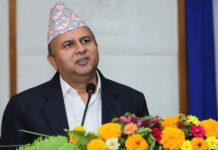










Pokhara, 23 February | Amidst the nationwide election fervor, Upendra Yadav, Chairman of the Janata Samajbadi Party (JSP) Nepal and a prominent leader of the Madhesh movement, has voiced significant concerns regarding the future of Nepal’s political landscape. Speaking during his campaign in Saptari Constituency No. 3, Yadav clarified that his decision to contest from various districts over the years—ranging from Morang and Sunsari to Bara and Saptari—is a reflection of the public’s immense affection and demand rather than a fear of political risk. He emphasized that Saptari 3, despite being part of a relatively accessible district, remains “remotely underdeveloped” in terms of basic infrastructure and quality of life. Yadav asserted that his current candidacy is a strategic move to address this backwardness and to challenge the internal colonization that has historically plagued the Madhesh region.
Reflecting on five decades of political struggle, Yadav underscored that the transition from an absolute monarchy to a federal democratic republic is a historical milestone achieved through immense sacrifice. He hit back at emerging political forces and critics who are questioning the relevance of federalism, labeling their demands as regressive. According to Yadav, the perceived failures of provincial governments are not a failure of the system itself but a direct consequence of the central government’s reluctance to devolve power. He argued that provinces have been treated as mere “geographical maps” with their “hands and feet tied,” deprived of essential administrative, legal, and security resources. He took pride in the Madhesh Province for being the only state to establish its identity based on cultural and historical roots, whereas other provinces remain named after rivers, which he considers a lack of visionary recognition.
On the economic front, Yadav presented an ambitious vision of creating 5 million jobs within the next five years. He argued that the modernization and industrialization of agriculture are the keys to solving Nepal’s unemployment crisis. By integrating science and technology with land management and dairy or meat industries, he claimed that Nepal could transform from a labor-exporting nation to one that requires importing labor, citing success stories from Israel and Punjab. Furthermore, he dismissed the current trend of leaders declaring themselves as future prime ministerial candidates, calling it “political immaturity” in the absence of a clear parliamentary majority. Yadav predicted that the upcoming parliament would likely be even more fragmented or “hung” than the previous one, leading to increased difficulty in maintaining political stability. He attributed the current premature election cycle to the failures of the previous NC-UML coalition and warned that post-election challenges would intensify as long-standing socio-economic crises remain unresolved. For Yadav, the real “threat” in this election is not any rival candidate, but the massive poverty and systemic exclusion that continue to haunt the people of Madhesh.