
















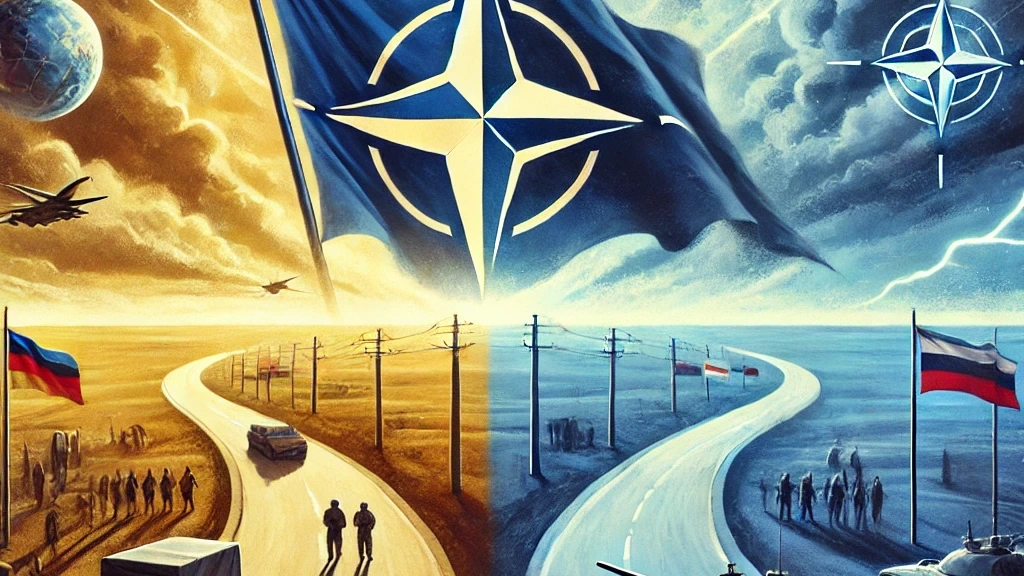

Pokhara, 28 April | The North Atlantic Treaty Organization, widely regarded as the backbone of global security since the end of the Second World War, is currently facing one of the most uncertain and challenging phases in its history. A recently leaked confidential email, reportedly originating from within U.S. defense circles and circulated through international media channels, has triggered widespread debate among diplomatic and geopolitical analysts. The contents of the document suggest a significant shift in the United States’ foreign policy, particularly in its approach toward long-standing allies, raising serious concerns about the future cohesion of NATO.
According to the leaked communication, the United States appears to be adopting a more rigid and transactional approach to its alliances. This emerging doctrine prioritizes immediate strategic returns, military cooperation, and economic contributions over traditional values such as shared democratic principles and mutual trust. Analysts describe this shift as a move toward “transactional diplomacy,” a framework in which alliances are treated less as enduring partnerships and more as conditional arrangements based on reciprocal benefits. This change is widely seen as a departure from NATO’s foundational philosophy of collective defense and solidarity.
The immediate trigger for this policy shift is believed to be the recent tensions involving Iran. As the United States explored potential military options against Iran, several NATO member states reportedly hesitated to provide logistical and operational support. Spain, in particular, has been highlighted as a key point of contention. Reports indicate that Spain declined to allow U.S. military aircraft to use its airspace and restricted access to critical military bases within its territory. Washington has interpreted these actions as a breach of alliance obligations, viewing them not merely as diplomatic differences but as failures to uphold the core responsibilities of NATO membership.
From the U.S. perspective, NATO membership is not simply a guarantee of security but also a commitment to actively support collective military initiatives when required. The perceived lack of cooperation from certain allies has led to growing frustration within American strategic circles. The leaked email suggests that punitive measures against non-cooperative member states are under consideration, with the aim of reinforcing discipline and deterring future dissent. This approach reflects a broader effort to reshape NATO into a more compliance-driven alliance aligned closely with U.S. strategic priorities.
Spain’s situation is particularly significant because it illustrates the potential consequences of diverging from U.S. expectations. Analysts argue that targeting Spain could serve as a warning to other NATO members, signaling that non-alignment with U.S. military objectives may carry tangible costs. Such a strategy, however, risks undermining the principles of equality and mutual respect that have traditionally defined NATO’s internal dynamics. It may also deepen divisions within the alliance, as member states reassess their own positions in relation to U.S. policies.
The case of the United Kingdom adds another layer of complexity to the unfolding situation. Historically regarded as the United States’ closest strategic partner, the UK now finds itself navigating an increasingly delicate relationship with Washington. Reports suggesting that the U.S. might reconsider its support for British sovereignty over the Falkland Islands have raised alarm in London. The Falklands issue is deeply embedded in British national identity and has previously led to armed conflict. Any indication of wavering U.S. support is therefore seen as a significant geopolitical signal, potentially reshaping long-standing transatlantic ties.
This evolving dynamic underscores the broader transformation of NATO under a transactional framework. The alliance, once anchored in the principle of “one for all and all for one,” is increasingly being viewed through the lens of cost-benefit calculations. Member states are now compelled to evaluate not only their commitments but also the potential consequences of non-compliance. This shift introduces a level of uncertainty that could weaken internal cohesion and erode the sense of shared purpose that has sustained NATO for decades.
European nations, in response to these developments, are beginning to reconsider their reliance on the United States for security. The concept of strategic autonomy has gained renewed momentum, with countries such as France advocating for a more independent European defense architecture. This shift is driven by the realization that overdependence on a single external power may expose Europe to vulnerabilities, particularly in times of political divergence. Efforts to strengthen indigenous defense capabilities and reduce reliance on U.S. military infrastructure are likely to intensify in the coming years.
At the same time, the apparent divisions within NATO are creating opportunities for other global powers. China and Russia, in particular, are closely monitoring the situation and adjusting their strategies accordingly. China’s approach focuses on expanding economic ties with Europe, positioning itself as a reliable partner in contrast to what it portrays as an unpredictable United States. Russia, on the other hand, sees the weakening of NATO unity as an فرصة to enhance its influence in Eastern Europe and beyond. The interplay of these dynamics is contributing to the gradual emergence of a multipolar world order.
The implications of this transformation extend far beyond NATO itself. As the alliance grapples with internal disagreements and shifting priorities, the broader architecture of global security is undergoing significant change. Smaller and medium-sized nations are increasingly required to navigate a complex landscape in which traditional alliances offer less certainty. They must balance competing influences and adapt to a system where power is distributed across multiple centers rather than concentrated in a single dominant actor.
In conclusion, the leaked email serves as more than just a glimpse into internal policy discussions; it represents a critical moment in the evolution of international relations. The transition toward transactional diplomacy is redefining the nature of alliances, challenging established norms, and reshaping the global balance of power. Whether NATO can adapt to these changes while preserving its core principles remains an open question. What is clear, however, is that the alliance stands at a निर्णायक crossroads, with decisions made in the near future likely to determine its relevance and effectiveness in an increasingly complex world.