












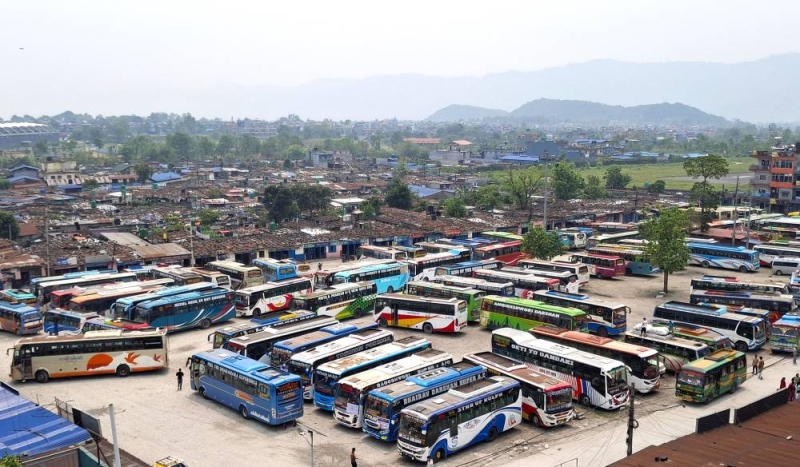

Pokhara, 8 May | Pokhara Metropolitan City has intensified its campaign to reclaim encroached public and government-owned land across key areas of the city. Following a public notice issued on April 17 directing people to vacate illegally occupied public land and structures, the Pokhara Valley Town Development Committee also published a separate notice on April 21 asking occupants to leave land owned by the committee. The move has accelerated efforts to clear long-disputed areas around Prithvi Chowk, the old bus park, institutional zones, and school properties that have remained under occupation for decades.
According to the metropolitan city’s recent study, only around 19 to 20 ropanis of the total 205 ropanis of land in the Pokhara bus park area remain vacant. The rest has been occupied by unmanaged settlers, temporary structures, political party-affiliated labor organizations, commercial tenants, and social institutions. Several labor unions linked to major political parties, including the CPN-UML, Nepali Congress, and Maoist groups, had constructed office buildings on government land and rented out commercial shutters for years. Critics have repeatedly argued that organizations were collecting rent from public property without paying any revenue to the state.
Mayor Dhanraj Acharya said organizations that had ignored repeated notices and negotiations are now gradually agreeing to vacate the occupied buildings under legal procedures. According to him, political party-affiliated labor organizations and institutions operating in the Prithvi Chowk institutional area have agreed to leave the premises by June 22. Some business operators have already begun removing tenants from commercial spaces. The metropolitan city plans to demolish several structures after the land is cleared in order to widen the road connecting Prithvi Chowk to the Machhapuchhre Bank area. Officials believe expanding the road into a two-lane corridor will significantly reduce chronic traffic congestion in the busy commercial zone.
The city has also announced plans to remove the public toilet located near the entrance of the Hong Kong Market area and relocate related facilities to the newly constructed Pokhara Ghar complex. Similarly, buildings previously occupied by Maoist-affiliated organizations near Shantiban Agriculture Market are also being vacated, and discussions are underway regarding the future use of those structures for government purposes.
Meanwhile, another major development has taken place at Amar Singh Secondary School, where 51 business operators have agreed to remove temporary structures built on school land by June 17. The land, located along the Prithvi Highway, had gradually turned into a commercial strip over several decades. Despite repeated requests from the school administration, the structures remained in place until recent court decisions ruled in favor of the school. Following discussions involving city officials, school representatives, ward authorities, and business representatives, an agreement was reached to clear the area peacefully. School officials stated that if new commercial structures are developed in the future, the displaced business operators may be given priority.
Pokhara Metropolitan City says the campaign is part of a broader effort to protect public property, manage urban development, and restore order in areas affected by long-term encroachment. Authorities claim earlier attempts had failed due to political influence and weak implementation, but the current administration is determined to enforce legal decisions and reclaim public land for public use.