















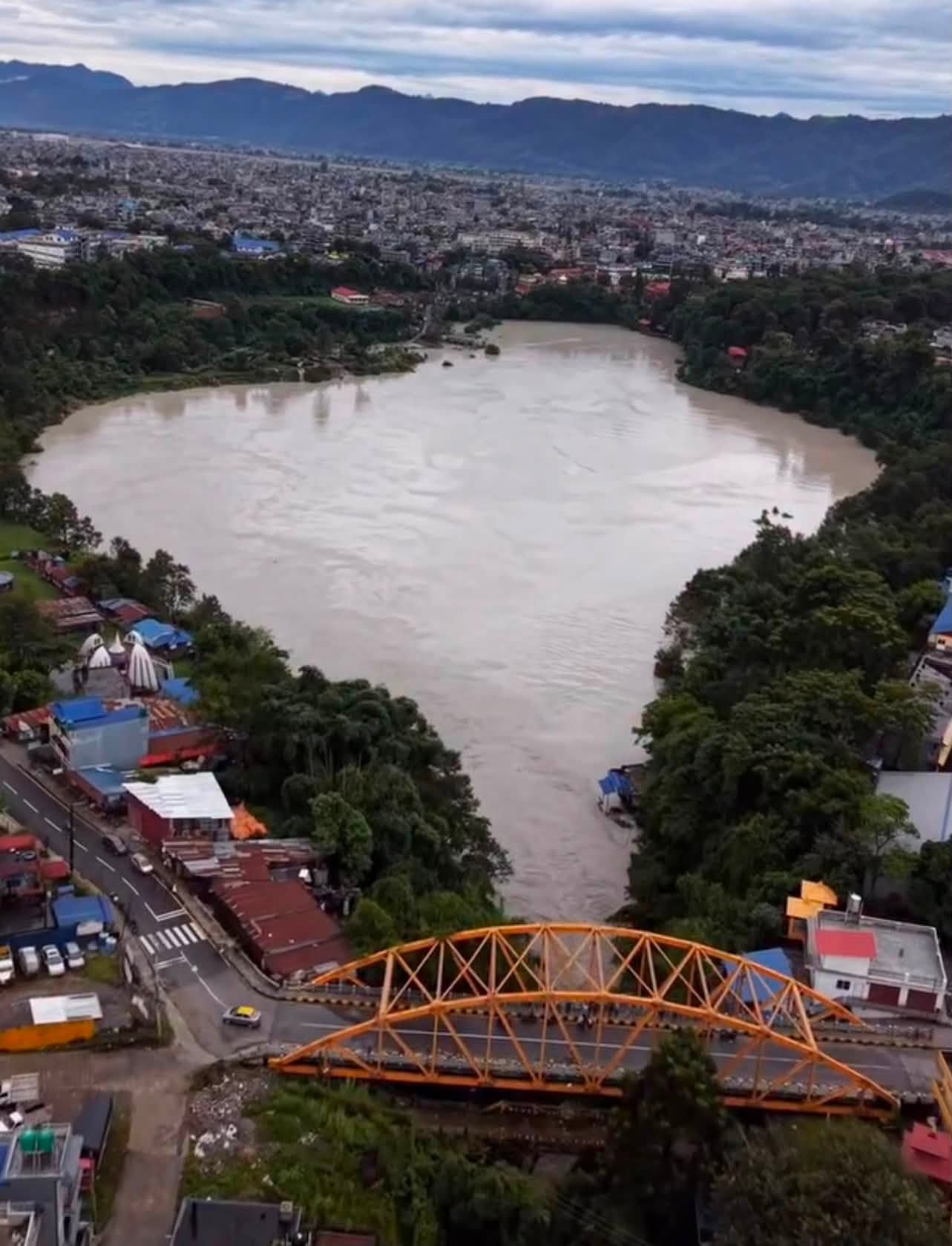

Pokhara, 27 September | A large pool of water has formed in Pokhara’s Ramghat area after the flow of the Seti River increased following continuous heavy rainfall in Kaski. The rising water level has inundated part of the cremation site, while settlements and temples around Ramghat have also been exposed to increased risk. A large body of water has developed from Tulsi Ghat toward the area near Shanti Ban, with the water level appearing significantly higher than in previous instances. Claims circulating on social media that the Seti River has been completely blocked and turned into a lake have raised concern among local residents. However, stakeholders and experts say the current situation does not mean that the river has been completely blocked. Ramghat has experienced similar temporary water accumulation almost every year during periods of above-average rainfall.
Engineer Dr Narayan Gurung, who has studied the Seti River and its potential disaster risks, said the narrow gorge through which the river passes near Shanti Ban causes water to accumulate when the river’s flow increases. He recalled that a similar pool formed in Ramghat in 2018, when the water level reportedly came within around 1.5 to 2 metres of the edge of Shanti Ban. According to Gurung, the Seti flows through relatively wider sections before entering narrow gorge-like sections, or bottlenecks. Such narrow passages are found around the KI Singh Bridge, Narayan Than, Ramghat and Ratopairo, where increased river flow can create temporary obstructions and water accumulation.
Experts have warned that the recurring formation of such pools should not be dismissed as a routine phenomenon. They say the situation could become significantly more dangerous if the banks or narrow gorge sections collapse while the river is already carrying a high volume of water, or if another major flood enters the river system. Previous studies have also warned about erosion along the riverbanks and changes in the river channel from the China Bridge area toward Ratopairo. Studies have indicated that the river channel at Ramghat narrows to about 6.2 metres in width in some sections.
Meanwhile, Kaski has been experiencing very heavy rainfall since September 24. Weather authorities recorded 143.4 millimetres of rainfall in Kaski over the previous 24 hours, while Lumle, one of Nepal’s areas known for high rainfall, recorded 126.2 millimetres. Local authorities have warned of possible floods and landslides and restricted rural and long-distance transportation as a precaution. Rescue and security teams have been placed on standby with necessary equipment. According to Kaski police, around 400 tourists visiting areas including the Annapurna, Mardi Himal and Kori trekking routes have been moved to safer locations, while people preparing to begin treks have been prevented from proceeding. Authorities have urged residents and visitors to remain alert as the Seti River’s flow and the water level around Ramghat could rise further.