






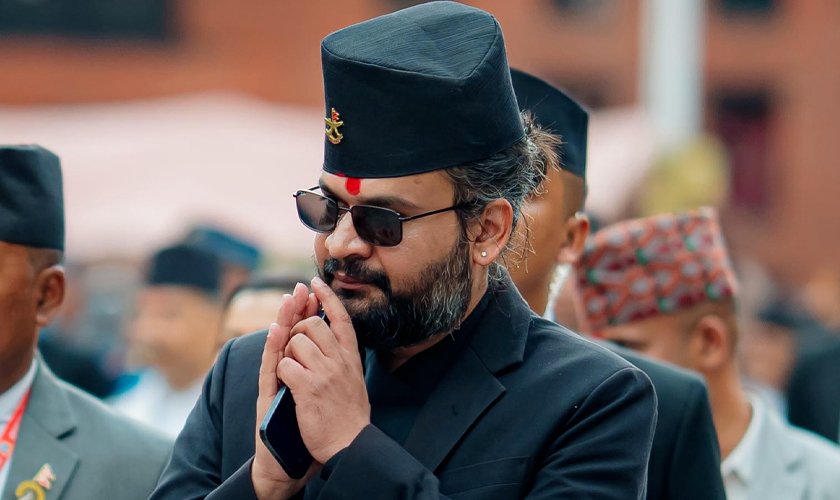

Pokhara, 27 March| Nepali rapper-turned-Prime Minister Balen Shah has carved a unique path in both music and politics, using rap as a powerful medium to express dissent, inspire youth, and challenge social injustices. His journey, marked by a single yet historic rap battle appearance and later record-breaking musical releases, reflects a blend of artistic rebellion and public leadership that continues to shape Nepal’s contemporary cultural and political narrative.
Balen’s entry into the Nepali rap scene gained widespread attention when he participated in what remains his first and only rap battle. Despite being new to the competitive stage, he delivered a performance that redefined expectations within the Nepali hip-hop community. His sharp lyrical responses, confident delivery, and ability to construct spontaneous verses showcased not only technical skill but also intellectual depth. The battle itself was not merely about winning or losing; it symbolized a new form of expression where words became tools of resistance and identity.
During the battle, his opponent initially mocked his appearance, attempting to undermine his presence. However, Balen’s composed yet assertive response turned the narrative in his favor. His lyrics emphasized versatility, asserting that he was not just a rapper but a true music artist capable of transcending genres. This moment resonated strongly with audiences, many of whom saw him as a voice of authenticity in a rapidly evolving music culture.
The rise of rap in Nepal was significantly influenced by pioneers like Yama Buddha, who brought the genre to the streets and gave it a social dimension. In that environment, Balen emerged as a figure who carried forward the spirit of free expression. Rap battles, often characterized by aggressive language and raw emotion, served as a platform for youth to articulate their frustrations without restraint. Balen’s participation in this culture positioned him at the forefront of a movement that valued honesty over conformity.
Beyond performance, Balen used his music to critique systemic issues, particularly corruption and abuse of power within state institutions. His songs often addressed the behavior of law enforcement, highlighting issues such as bribery, discrimination, and misuse of authority. At a time when young people were increasingly frustrated with governance and social inequality, his music provided both representation and release. His lyrics, though sometimes harsh, captured the lived realities of many citizens and amplified voices that often went unheard.
One of the most talked-about possibilities in Nepali hip-hop was a potential rap battle between Balen and Laure. The idea generated immense excitement among fans, with discussions spreading across social media platforms. However, as Balen transitioned into politics and assumed leadership roles, including his tenure as mayor and later as Prime Minister, the anticipated showdown never materialized. Laure himself later acknowledged that such a battle was unlikely given Balen’s responsibilities in public office.
Despite his political commitments, Balen never fully distanced himself from music. Even during his tenure as mayor, he continued to release songs, maintaining a connection with his artistic roots. His recent track “Jay Mahakali” quickly achieved a major milestone by becoming one of the most viewed Nepali songs within a short period. The song, infused with themes of courage and patriotism, reflects a shift from purely critical expression to motivational and nationalistic messaging.
Balen’s story illustrates how art and politics can intersect in meaningful ways. His rise suggests that music, particularly rap, can serve as a catalyst for broader social engagement. It also highlights how personal expression can evolve into public responsibility. Had the socio-political conditions been different, his journey might have remained confined to music. Instead, his artistic voice propelled him into leadership, where he continues to influence change on a larger scale.
Today, Balen Shah stands as more than just a political figure or musician; he represents a generational shift driven by youth aspirations, creative freedom, and a demand for accountability. His journey from rap battles to national leadership underscores the transformative power of expression in shaping both identity and destiny.