









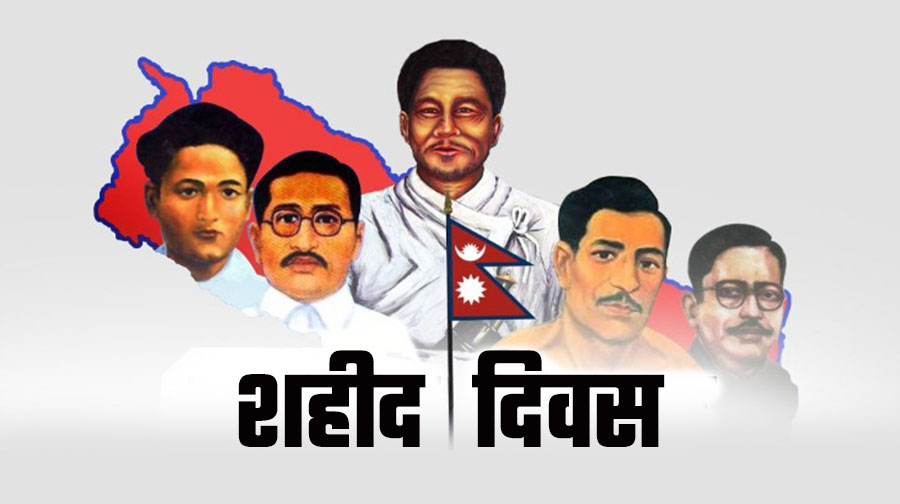

Pokhara, 30 January | Nepal is observing National Martyr’s Day today with various commemorative events held across the nation to pay solemn tribute to the heroes who sacrificed their lives for the cause of democracy, national sovereignty, and the welfare of the people. This historic day, celebrated annually on the 16th of Magh, specifically honors the four legendary martyrs—Shukraraj Shastri, Dharma Bhakta Mathema, Dashrath Chand, and Gangalal Shrestha—who were executed by the autocratic Rana regime in 1941 for advocating democratic reforms. The tradition of officially celebrating this day began in 1955 under the coordination of the then Kathmandu Municipality. Reflecting on history, the Rana rulers executed Shastri at Teku on January 23, Mathema at Sifal on January 26, and both Chand and Shrestha at Shobha Bhagwati on January 29, 1941. Their ultimate sacrifice laid the groundwork for the 1951 revolution that eventually ended the 104-year-old Rana rule.
On this significant occasion, President Ramchandra Paudel and Prime Minister Sushila Karki, along with top political leaders, expressed their profound respect for the martyrs. President Paudel, in his official message, urged all citizens to be dedicated in mind, word, and deed toward fulfilling the aspirations of the martyrs. He emphasized that establishing sustainable peace, good governance, and prosperity through the federal democratic republican system is the truest way to honor their legacy. Similarly, Prime Minister Karki expressed her resolve to ensure that no mother loses her child again in the struggle for rights, specifically mentioning and honoring the young warriors of the recent ‘Gen-Z’ movement who fought for justice, equality, and accountable governance. She stressed that moral values and respect for citizens must remain the fundamental duties of every ruler.
The political landscape saw a unified voice in honoring the past, yet diverse opinions on the current state of governance. Former Prime Minister and UML Chairman KP Sharma Oli remarked that the democratic rights enjoyed by society today are the direct result of the martyrs’ sacrifices and the joint movements of the Communist and Congress parties. Meanwhile, Nepali Congress President Gagan Thapa called for a collective pledge to follow the path shown by the martyrs, spanning the history from the 1951 revolution to the recent 2025 Gen-Z protests. Adding a critical perspective, Rastriya Swatantra Party senior leader Balendra Shah (Balen) noted that while political systems have changed over the last 85 years, the inherent character of power has remained stagnant. He claimed that the responsibility to end deep-rooted corruption and build an economically advanced Nepal, as envisioned by the martyrs of both the past and the recent Gen-Z movement, now rests on the shoulders of the new generation of leaders.