













Pokhara, 7 August| Nepal’s first industrial enterprise, Biratnagar Jute Mills, which has remained closed for years and deteriorated into a derelict site, may have a chance of resuming operations after the government formed a task force to study its revival. The formation of the task force has raised hopes that the historic mill could once again return to production. Chairman of the Biratnagar Jute Mills Board of Directors, Nandalal Devkota, said the possibility of reopening the industry has increased following the government’s decision to initiate a formal study and preparation process.
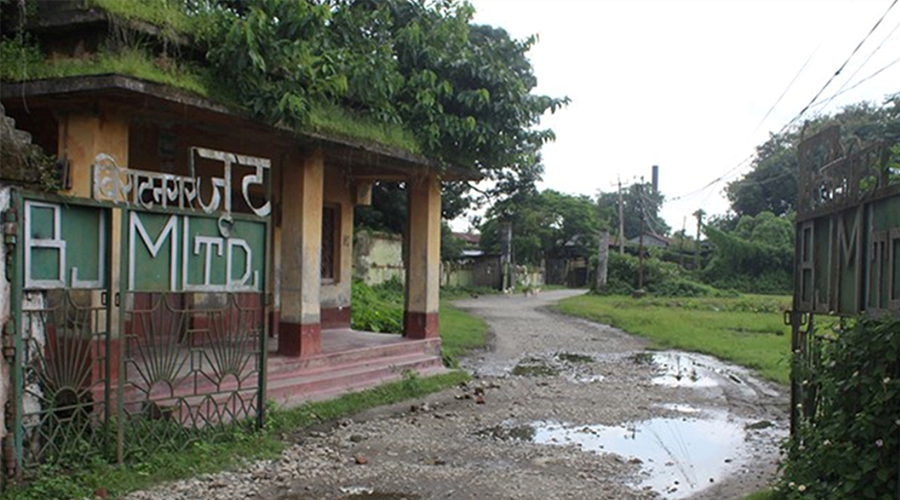
The present condition of the mill reflects years of closure and neglect. Trees and weeds have surrounded the old industrial structures, while inside the premises there are rusted machines, spider webs, accumulated dirt, stagnant water and a damp smell. Torn sacks and abandoned motor components can be seen in different sections of the factory. Several parts of the walls have developed cracks, while the southwestern wall has collapsed in places. Rainwater leaks through the roof, and several valuable machine parts and smaller equipment have reportedly disappeared from the premises.
Established in 1993 BS, Biratnagar Jute Mills once provided employment to around 8,000 people. The mill operated in three shifts and was an important centre of industrial activity in the country. Its establishment also contributed to the expansion of industrial enterprises in the Morang-Sunsari industrial corridor. The mill has a significant place in Nepal’s industrial history and is also associated with the country’s democratic movement.
Today, only nine employees remain at the mill, including five security guards. The bell that once helped thousands of workers keep track of their working shifts continues to ring every hour, but it is now operated by security guards taking turns. The sound of the bell stands in sharp contrast to the silence surrounding the abandoned factory. Although production has stopped, the continued ringing of the bell has become a reminder of the mill’s industrial past and the possibility of its revival.
There are different estimates regarding the investment required to restart the mill. Board Chairman Devkota said an investment of around Rs 500 million to Rs 600 million could be sufficient to bring the industry back into operation. He believes the government should not directly operate the factory but should facilitate the process and hand responsibility to a capable private-sector group. According to him, the large area occupied by the mill could also be used for other industrial activities alongside modern jute production.
Former mill operator Phulkumar Lalwani also believes that the factory could be brought back into operation with a relatively small investment. He argues that some of the existing machines remain usable. However, he also prefers a private-sector operating model rather than direct government management. According to him, leasing the mill to a capable private company could provide better management, investment and market-oriented decision-making.
The major challenge, however, is whether the old machines and damaged infrastructure can support competitive production. Dharmananda Sanjel, who has knowledge of the mill, argues that the industry cannot compete in the current market by simply returning to its traditional production system. The machines are outdated, while modern production technologies have already transformed the jute industry. He believes new technology must be introduced if Biratnagar Jute Mills is to produce goods that can compete in domestic and international markets.
Devkota also acknowledges the need for modernization. He says that while some of the old machinery may still be usable because the basic technology used in jute production has not fundamentally changed, modern equipment will be necessary to compete effectively. He points to the potential of the Indian market, which is geographically close to Biratnagar. According to him, the mill could focus on environmentally friendly jute products such as shopping bags, handbags and other alternatives to plastic products.
The history of the mill includes several attempts to revive its operations. The government operated the industry for many years before handing its management to Golchha Organisation as part of a privatization effort. However, the organization could not operate the mill successfully. In 2058 BS, the government closed the industry after paying around Rs 550 million to approximately 2,000 employees.
In 2069 BS, Winsome International of Kolkata was given responsibility for operating the mill. The company had taken the mill on a 25-year lease, with an agreement that 33 KVA electricity would be made available for operations within six months. However, the required electricity was not provided even after one and a half years, leading the company to withdraw from the agreement and discontinue operations.
The mill was briefly revived again in 2075 BS after Basanta Ban became chairman of its board. Production of jute-related materials was started, but operations stopped again after a short period. Small machines brought for production have since disappeared from the factory premises and are reportedly stolen. Large machines, meanwhile, remain inside the deteriorating industrial structures.
Manoj Khadka, a supervisor working at the mill, believes that the industry can still be revived if its structures are properly repaired. He says several internal structures remain relatively strong and could be used after necessary maintenance. His view suggests that the entire industrial complex may not necessarily have to be rebuilt from scratch, although significant repair, investment and modernization would be required.
Journalist Anantaraj Neupane, who has closely followed and studied the mill for years, argues that restarting the factory in its old form would not be practical. According to him, the industry needs to respond to changes in technology, consumer demand and market competition. Producing traditional jute goods with outdated machines would not be enough to make the mill commercially viable. He also supports handing the mill to the private sector rather than keeping it under direct government operation.
The proposed revival of Biratnagar Jute Mills therefore involves more than simply restarting old machines. Repairing deteriorated infrastructure, introducing modern technology, diversifying production, ensuring market access, improving management and attracting private investment will be crucial. The government’s task force now has the responsibility of assessing these issues and recommending a practical operating model.
If the study is followed by effective implementation, the historic mill could once again become a centre of production and employment. Its large industrial premises, proximity to the Indian market and the growing demand for environmentally friendly alternatives to plastic could provide opportunities for a modernized jute enterprise. For now, the rusted machines, damaged buildings and the hourly ringing of the old factory bell continue to tell the story of an industry waiting for a new beginning.