
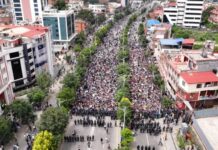









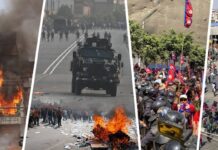




Pokhara, 9 September | Serious questions have been raised over the political circumstances surrounding the widespread violence, arson and destruction that unfolded in Nepal last year, particularly the events of Bhadra 24. The analysis argues that the episode remains one of the most mysterious incidents in the country’s recent political history because its organizers, leadership, declared objectives and broader political purpose have not been clearly established. It also contrasts the peaceful youth-led protests of Bhadra 23 with the destructive events that followed, arguing that the two developments should not automatically be treated as the same political phenomenon.
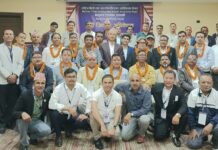
The discussion begins with the second General Convention of the CPN-UML’s विधान महाधिवेशन, held in Godavari, Lalitpur, from Bhadra 20 to 22 last year. The convention amended the party statute by removing previous restrictions related to the age of 70 and the maximum number of terms a chairperson could serve, thereby opening a path for then-chairman and Prime Minister KP Sharma Oli to seek another term. According to the analysis, the convention also presented an optimistic assessment of the country’s overall condition, with claims that development and construction would accelerate.
However, within a short period, the country experienced a dramatic political and security crisis. The analysis recalls that the situation deteriorated so rapidly that representatives attending the Godavari convention had not even returned to their constituencies before the country was engulfed in violence, while the then-prime minister reportedly had to be evacuated by helicopter for security reasons. The author questions how the government, security agencies, bureaucracy and state information mechanisms could have remained unaware of preparations for such a large-scale crisis. Public statements by Oli indicating that he himself did not have prior knowledge of the developments are cited as part of the continuing mystery.
A central question raised in the analysis is who organized the Bhadra 24 events. No individual or organization, it argues, has clearly claimed ownership of the episode or publicly established itself as its official organizer. The author therefore questions whether the events should properly be described as a revolution, movement or rebellion. A revolution normally has a defined political objective, leadership, demands, slogans and an identifiable organizational force, while a movement generally presents identifiable demands and seeks change through organized political pressure. The analysis argues that these conventional characteristics were not clearly visible in the Bhadra 24 events.
The distinction between a movement and a rebellion is also discussed. Both can represent dissatisfaction against those in power, but they can differ in methods, organization and political character. A peaceful movement can sometimes develop into a rebellion, particularly when confrontation escalates, but the analysis argues that the Bhadra 24 episode did not clearly display a declared leadership or identifiable organizational command structure. Although the government in power was removed, the Constitution and the broader state structure remained in place. On that basis, the author describes the episode as fundamentally chaotic and criminal rather than a conventional political revolution.
The destruction of major state institutions is presented as one of the most troubling aspects of the episode. The analysis raises questions about attacks and fires involving Singha Durbar, the Supreme Court, the President’s Office and business establishments. It asks how individuals claiming to represent change could deliberately target institutions containing historical records, state documents and important national heritage. The article argues that the identities of those who planned or directed such attacks must be established through credible investigation rather than political speculation.
Another major issue concerns the difference between the peaceful youth movement of Bhadra 23 and the destructive events of Bhadra 24. According to the analysis, many young people, artists, politicians, businesspeople and unemployed youths participated in the earlier protests because of dissatisfaction with governance and a desire for political change. The author suggests that some of these participants may not have known about any subsequent plans for widespread destruction. The analysis therefore argues that the aspirations and sacrifices of young protesters should not be discredited merely because violence and destruction occurred afterward.
It also asks what happened to the young people who participated in the original movement and whether their demands for change, good governance and accountability were actually addressed. Questions are raised about whether their views were incorporated into government policies, programmes and budgets and whether the people who benefited politically from the subsequent change were the same young people who had taken to the streets. The analysis suggests that many of the original protesters may have received little direct benefit from the political transformation and asks who ultimately gained from their sacrifice.
The purpose behind the Bhadra 24 destruction is another major issue raised in the article. The visible political consequence, according to the analysis, was the removal of the then UML–Nepali Congress government, the dissolution of the House of Representatives and the eventual rise of a new political force to government. However, the author argues that it would be difficult to conclude that such extensive destruction, arson and loss of life were carried out solely to change the government. The analysis instead raises the possibility that forces opposed to Nepal’s federal democratic republic and inclusive constitutional order may have had an interest in the upheaval.
The article further suggests that domestic and external interests may have intersected in the events. It refers to Nepal’s natural resources, geopolitical interests and subsequent foreign involvement while raising questions about whether outside powers may have supported or benefited from the political disruption. References are also made to developments involving China, Tibet and the Dalai Lama. These are presented as reasons for further investigation rather than as conclusively established evidence of foreign involvement. Given the seriousness of such allegations, determining their validity would require independent investigation and verifiable evidence.
The analysis also criticizes the government that emerged after the political upheaval. It claims that constitutional institutions have weakened during the subsequent period and that the legislature and executive have increasingly operated under political pressure. It questions whether elected lawmakers have been able to exercise independent judgment and whether Parliament has remained sufficiently effective in holding the government accountable. The article argues that the constitutional principle of parliamentary accountability should exist in practice rather than remain only as written language.
The independence and credibility of the judiciary are also questioned. The analysis refers to public dissatisfaction expressed by the Nepal Bar over issues involving the appointment of the chief justice and the functioning of the Constitutional Bench. It also raises concerns about the government’s use of ordinances and judicial responses to certain government decisions, arguing that continued institutional weakness could undermine public confidence in the judiciary. The author similarly criticizes what is described as inadequate implementation of the constitutional principle of inclusion in appointments to public offices.
The article ultimately argues that the federal, democratic and inclusive character of Nepal’s constitutional system must be protected. It calls for greater unity among left and democratic forces, stronger internal democracy within political parties, leadership transformation and generational transition. According to the analysis, repeatedly concentrating political power in the same leaders and allowing parties to become personality-centered has contributed to public frustration and created conditions for political instability.
The final argument is that political parties and constitutional forces must conduct a serious review of their own past decisions, leadership practices and failures. The author contends that the peaceful youth movement of Bhadra 23 should be recognized as an expression of dissatisfaction with the existing political order and a demand for change and good governance, while the destructive events of Bhadra 24 should be investigated separately and comprehensively. Identifying who planned the violence, who financed or organized it, who benefited from the resulting political transition and who was responsible for attacks on key national institutions are presented as questions that cannot remain unanswered.
The analysis concludes that the mystery surrounding Bhadra 24 is not merely a matter of historical curiosity. It argues that failure to establish the facts could weaken public trust in democracy, constitutional institutions, the rule of law and national sovereignty. A credible investigation, political self-review and institutional strengthening are therefore presented as essential steps if Nepal is to prevent another crisis of a similar nature.