












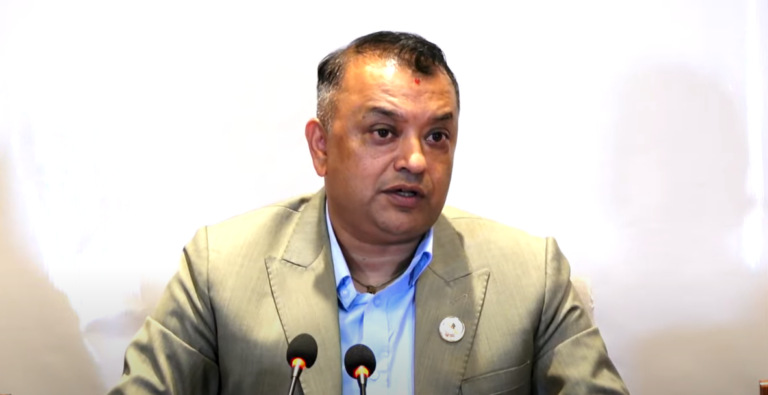

Pokhara, 17 February | In a significant political shift described as a “statutory rebellion,” the Nepali Congress has signaled a transformative era by not only refreshing its leadership but also recalibrating its core policy frameworks. Under the presidency of 49-year-old Gagan Kumar Thapa, the party is positioning itself as the first traditional political entity to authentically embrace the aspirations of the “Gen-Z” movement. Since his tenure as General Secretary, Thapa has consistently advocated for distinct national discourses surrounding political stability, good governance, national security, and foreign policy. His recent messages from Gandaki reflect a growing alignment with a disillusioned intellectual and youth demographic that demands sincere commitment from political parties toward systemic integrity. The transition from an 80-year history to a youth-led presidency suggests a strategic move to reclaim lost public trust by proving that the “reformed Congress” is capable of fulfilling contemporary national mandates.
The primary focus of this political evolution centers on ensuring long-term stability through constitutional amendments. Since the promulgation of the Constitution on 3 October 2015, the prevalence of a mixed electoral system has frequently resulted in “hung parliaments,” preventing any single party from securing a majority for a full five-year term. To address this, the party is fostering debates on increasing the electoral threshold, implementing direct elections for provincial assemblies, and shifting the proportional representation system exclusively to the National Assembly. While some voices suggest the abolition of the provincial structure, the Thapa-led Congress emphasizes making provinces more accountable and effective rather than dismantling them. The core objective remains mitigating the “vicious cycle” of unstable governments at both federal and provincial levels, which has historically hindered national progress.
Governance and prosperity form the second pillar of this new political vision. Following the massive youth-led protests of 23 August, which expressed deep resentment toward the “syndicate” of traditional leaders like KP Sharma Oli, Sher Bahadur Deuba, and Pushpa Kamal Dahal, the Congress has attempted to differentiate itself. While other parties like the CPN (Maoist Centre) rebranded by dropping “Maoism” or the UML relied on technical majorities to retain old faces, the Nepali Congress has taken concrete steps toward internal purification. By denying election tickets to leaders tainted by corruption allegations, such as Bal Krishna Khand and Mohan Bahadur Basnet, while maintaining the legal principle of “innocent until proven guilty” for others, Thapa has signaled a departure from cronyism. This approach aims to establish a governance model where human dignity, education, health, and social security are prioritized over the populist but hollow promises of the past.
Furthermore, the party is refining its stance on national security and foreign policy amidst a complex geopolitical landscape. Recognizing challenges like border encroachment, international terrorism, and the influence of middlemen, the Congress stresses the need for a sensitive and unified national security policy. Regarding foreign affairs, Thapa and Vishwa Prakash Sharma have proposed that foreign policy should belong to the nation rather than individual parties. Adhering to the non-aligned policy established by BP Koirala in 1959, the party seeks to balance relations with India and China without succumbing to bilateral friction. However, a modern challenge identified by the leadership is the “Deepfake terror” and AI-generated misinformation, which has already impacted global elections. By countering such digital threats with fact-based manifestos and a commitment to “Prosperity through Resolution,” the Nepali Congress aims to lead the nation toward stability, aiming for a “100-plus seat” victory in the upcoming elections to ensure a Gagan Thapa-led government.