













Pokhara, 7 March| The political landscape of Nepal has undergone a tectonic shift as the 2082 House of Representatives elections delivered a crushing blow to the country’s oldest democratic force, the Nepali Congress. In a result that has stunned political observers and party insiders alike, the Congress has faced its most devastating electoral defeat in history, managing to secure victory in only 8 out of the 165 first-past-the-post constituencies. As the Rastriya Swatantra Party (RSP) surges toward a clear majority, the traditional power structure dominated by legacy parties appears to have crumbled under a wave of youth-led dissatisfaction and a demand for radical change. This electoral upheaval has not only decimated the party’s seat count but has also seen the fall of high-profile leaders, including two General Secretaries and two Assistant General Secretaries, marking a total collapse of the party’s organizational vanguard.
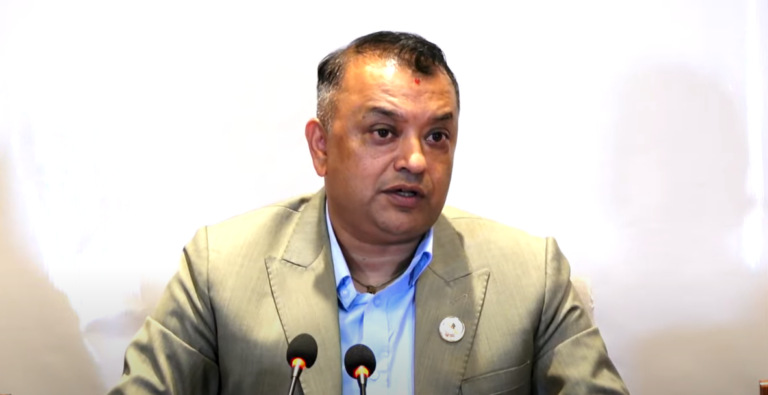
The preliminary results indicate a massive rejection of the traditional political establishment. Even the newly appointed party President, Gagan Kumar Thapa, who assumed leadership following a special convention in January with the hope of rebranding the party, finds himself in a precarious position. Contesting from Sarlahi-4, Thapa is currently trailing behind Dr. Amaresh Kumar Singh of the RSP. This is particularly striking given that the Congress had projected Thapa as its prime ministerial candidate, hoping his youthful image would bridge the gap with the “Gen-Z” voters who spearheaded recent social movements. However, political analysts like C.K. Lal argue that the attempt to present a new face was insufficient to mask the party’s long-standing issues. Lal noted that while leaders like Sushil Koirala or Sher Bahadur Deuba may have been the drivers of the party since 2015, the younger crop of leaders like Gagan Thapa served as co-drivers, making them equally accountable in the eyes of a disillusioned public for the party’s past failures and corruption allegations.
Despite the somber atmosphere at Sanepa, the Congress leadership has moved quickly to acknowledge the public’s verdict. Vice President Bishwa Prakash Sharma stated that the decision of the voters is entirely acceptable to the party. In a notable gesture of democratic grace, Sharma compared the rise of the RSP through the ballot to the previous emergence of the Maoists through the “bullet,” welcoming the newcomers to the center stage of national politics. He remarked that given the signals already present in the 2079 elections, this result was not entirely unexpected. Sharma emphasized that while there is great hope attached to the new force, it must not turn into another cycle of public disappointment, asserting that the Congress would fulfill its role by providing both support and necessary oversight on national issues. Meanwhile, party spokesperson Devraj Chalise admitted that while the results were unexpected in their magnitude, the Congress remains committed to its democratic roots and will undergo deep self-reflection to correct its past mistakes.
The list of the few successful Congress candidates includes Khadga Bahadur Budha from Jajarkot, Bharat Bahadur Khadka from Doti, Basana Thapa from Dailekh-1, Santosh Subba from Terhathum, Bharat Kumar Swar from Achham-1, Mohan Acharya from Rasuwa, Yogesh Gauchan Thakali from Mustang, and Tek Bahadur Gurung from Manang. This is a far cry from the 2079 elections where the Congress emerged as the largest party with 57 seats, or the glory days of 1991 and 1959 when it held comfortable majorities. The current collapse mirrors the party’s 2017 slump when it was reduced to 23 seats, but the scale of the 2082 defeat is significantly more profound. As the RSP continues to lead in over 120 seats, the Nepali Congress faces an existential crisis, forcing it to rethink its political style, strategy, and connection with a generation that no longer values historical legacy over contemporary performance and integrity.